
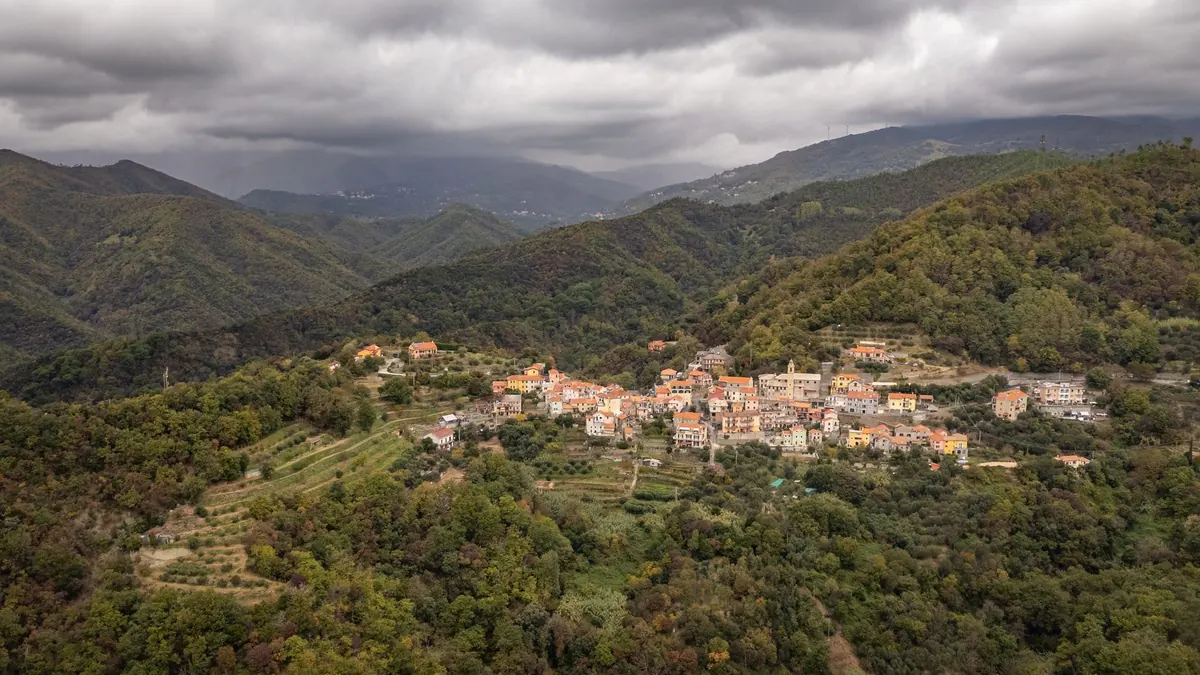
Choosing a rural base in Italy is less about finding the most beautiful village and more about finding the one that fits the way you actually spend a day. Two towns can look identical in a photograph — same stone lanes, same view over a valley — and behave completely differently on a wet Tuesday in November. The difference is rarely aesthetic. It is a train timetable, a grocery that stays open past one o'clock, a bar within walking distance, a bit of life left in the piazza after the summer people go home. What follows is a working checklist: the questions worth answering before you put down a deposit.
Start with the train line, not the photograph
Open a map and find the nearest railway station before you fall in love with the town itself. Then ask how far it actually is, and what the road between them looks like. A station marked "5 km" can mean a ten-minute drive or a forty-minute walk along a road with no shoulder and a ditch on either side.
Next, look at the timetable for a random Tuesday in March rather than a Saturday in July. Regional lines in rural Italy often run a handful of services a day, timed around school hours and commuters, with almost nothing on Sunday. That may suit you perfectly if you plan to read, cook and stay put. It will not suit you if you imagined day trips to three cities a week.
If you are renting a car — and in much of rural Italy you eventually will — check the parking situation in the old town before anything else. Many historic centres are closed to non-residents, or have ZTL cameras that issue fines long after you have gone home. Ask the host, in writing, where the car goes. "Nearby" is not an answer.
The wet Wednesday test: services that matter
Tourist infrastructure and living infrastructure are different things. A town with four restaurants and a wine bar can still be awkward to live in for a fortnight. Run through the unglamorous list:
- A grocery you can reach without a car, or a market day you can plan around.
- A pharmacy, and a sense of where the nearest out-of-hours service is.
- An ATM that is not permanently out of order, and a bank if you need one.
- A bar that stays open in the afternoon, when everything else closes.
- A hardware shop or emporio for the small things — adapters, batteries, a corkscrew.
- A post office, which in small towns is also often the place to pay bills and sort paperwork.
Opening hours deserve their own paragraph. Rural Italy still keeps the old rhythm in many places: shutters down from roughly one to four, half-day closing midweek, Sunday mostly quiet. That is charming when you are on holiday and inconvenient when you need bread at 2pm. Check the hours of the nearest grocery on Google before booking, then assume they are optimistic.
Walkability is a daily question, not a holiday one
Every hilltop village is walkable for an hour, in flat shoes, with nothing to carry. The real test is the third trip of the day with two bags of shopping and a bottle of water.
Look at the gradient between the apartment and the nearest shop. Look at whether the streets are steps or ramps. Look at whether there is a pavement on the road out of the centre, and whether the streetlights work in the lane you would walk home along after dinner. A town where you can stroll to a viewpoint is not automatically a town where you can manage without a car for a week.
It also helps to know the difference between the centro storico and the frazione — the hamlet a few kilometres away that shares the postcode but not the amenities. Listings sometimes blur the two. Pin the exact address on a map and measure.
Read the season before you book
Rural Italy has a strong pulse, and it does not beat evenly. Ask what the town is like in the month you are going, not in the month the photographs were taken.
August is not a season — it is an event
In many villages, August brings the sagra, the patron saint festival, visiting relatives and a full piazza every evening. It is wonderful and it is loud. Book early, expect higher rates, and do not plan on quiet dinners at 8pm.
Winter is the honest test
Ask a direct question of your host or the tourist office: how many bars and restaurants are open in January? In some towns the answer is one, and it closes at seven. In others, a small year-round population keeps a bakery, a café and a Sunday lunch going. Both can be good holidays — they are just different holidays.
Weather matters too, in a practical way. Valley towns can be foggy and cold in a way the coast twenty minutes away is not. Stone houses hold the chill. Check whether heating is included in the rental price or billed by consumption, because winter bills in an old house with single glazing can surprise people.
The apartment fine print
Rural rentals are often beautiful and idiosyncratic. Before booking, confirm the things that decide whether a stay feels easy: whether there are stairs and how many, whether the wifi is actually usable for work, whether there is a washing machine, and whether the kitchen has an oven or just a hob. Ask about parking, again. Ask about church bells if you are a light sleeper and the flat is on the piazza.
If a listing does not mention something you would notice within an hour of arriving, ask about it directly. Good hosts answer plainly; vague answers are information too.
Check the calendar and the closures
Before you commit to dates, glance at the local calendar. Harvest brings tractors and closed trattorias; the grape and olive seasons draw volunteers and fill small hotels. Mountain passes close with the first serious snow, which can add an hour to a drive you had planned as short. Some coastal and lakeside towns effectively shut down from November to March, with the shutters closed and the ferries reduced.
Also check market day. A weekly market can be the difference between a pleasant week and a slightly thin one — and it is worth arranging your arrival around it.
A pre-booking checklist
Run these ten steps before you pay anything, in this order:
- Pin the exact address, not the town name, on a map.
- Find the nearest station and read a weekday timetable in the off-season.
- Measure the walk to the nearest grocery, in minutes and in metres of climb.
- Check opening hours for the grocery, pharmacy and nearest bar.
- Confirm where the car sleeps, and whether the centre is restricted.
- Ask what is open in your month, and how many places serve dinner.
- Ask about heating, stairs, wifi and parking in writing.
- Look at the drive times to the places you actually want to reach.
- Check the calendar for festivals, harvests and closures.
- Book a short stay first if you can, then extend if the town fits.
The best base town is rarely the most photographed one. It is the one where the ordinary logistics quietly work — where you can buy dinner, catch a train, walk home in the dark and find the café open when you want it. Get those right and the beauty of the place has room to do its work.
Photo: Christoph Hanssen / Pexels
Related posts
More stories you’ll love reading